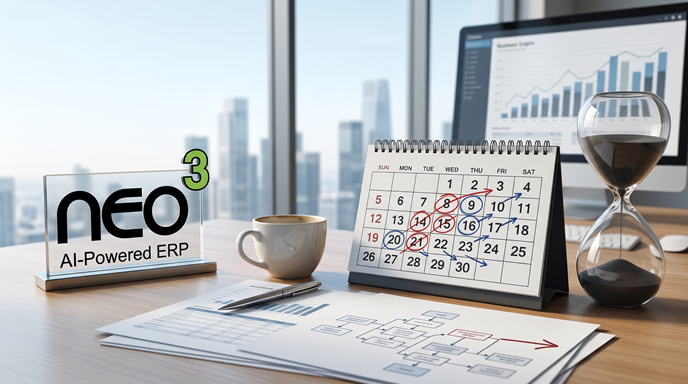
A prospect told me recently that they know they need to replace their ERP system. The problem is timing. Their current software is coming up for renewal, and they do not have enough time to evaluate a new system, implement it, convert the data, train everyone, test it, and go live before the deadline.
So they made the sensible decision: renew for another year and revisit the ERP replacement next year.
The problem is that next year has a funny way of looking a lot like this year. The orders still need to ship. The books still need to close. People still take vacations. Budgets still need approval. Someone important will still be tied up in another project. And eventually, renewal season comes around again.
That is how one-year delays quietly become three-year delays.
The perfect time to replace an ERP does not exist
ERP replacement is rarely postponed because the company does not need a better system. Most companies already know when the current ERP is creating problems. They see the spreadsheets, duplicate entry, manual reconciliations, reporting delays, and workarounds that have become normal.
The delay usually happens because the organization is waiting for a better time: a quieter quarter, a slower season, a period when finance is less busy, or a year without another major initiative.
That sounds reasonable. It is also usually imaginary.
Healthy companies are busy. If the business is growing, there will always be customers, deadlines, reporting requirements, competing priorities, and unexpected fires. Waiting for the business to become less busy before replacing a critical system can easily turn into waiting forever.
Renewal feels easier because it avoids disruption
Renewing the current system is easy. Nobody has to learn anything new. No data needs to move. No processes need to be redesigned. Nothing changes.
That makes renewal feel like the low-risk choice. In the short term, it often is.
But there is another question worth asking: what does another year of the current system actually cost?
Not just the renewal fee. The spreadsheets built around it. The extra reconciliation. The manual reports. The duplicate entry. The time spent searching for information. The decisions that take longer because nobody completely trusts the number.
Those costs rarely arrive as one invoice. They show up five or ten minutes at a time, across dozens of people, all year long.
Maybe the implementation model is the real problem
The irony is that many companies delay ERP replacement because they cannot afford the disruption of replacing the ERP.
But if replacing the system requires six, nine, or twelve months of disruption, maybe that assumption deserves to be challenged.
Your finance team still has to close the books. Operations still has to run. The warehouse still has to ship. Management still has a business to manage.
So the better question is not:
“When will we have time to replace the ERP?”
It is:
“How do we replace it without stopping the business?”
That leads to better questions about implementation speed, internal workload, data preparation, training, automation, and how much of the project the implementation partner should own.
What will actually be different next year?
Before signing another one-year renewal, ask one question:
What will be different next year that makes this easier?
Will finance suddenly be less busy? Will operations have fewer priorities? Will there be fewer deadlines?
Probably not.
If nothing about the implementation approach changes, there is a good chance the same conversation happens twelve months from now.
At some point, the cycle only breaks when the company stops waiting for the perfect time and chooses an approach designed around the business as it actually operates.
The waiting may be the hardest part.
But eventually, somebody has to stop renewing the problem.
Ready to stop pushing ERP replacement to “next year”?
NEO3 helps companies implement NetSuite with less disruption, less burden on internal teams, and a faster path to value.